

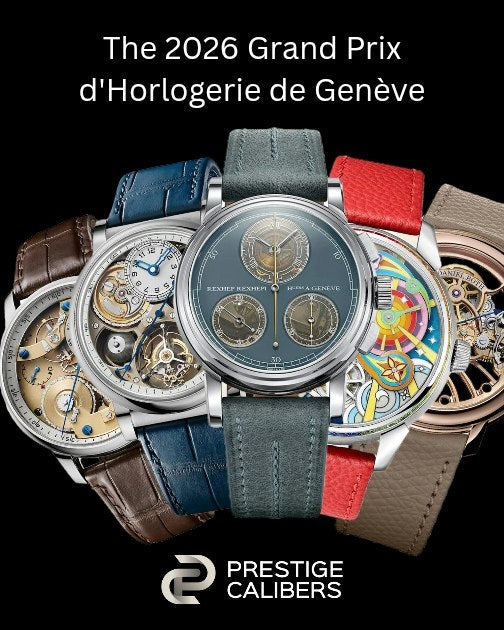
GPHG 2026 Winners: All 20 Award-Winning Watches Revealed
November 8, 2026 | Prestige Calibers Editorial
The winners of the 26th Grand Prix d'Horlogerie de Genève (GPHG) have officially been announced, bringing together some of the most remarkable achievements in contemporary watchmaking.
Held in Geneva on November 7, 2026, the prestigious ceremony recognised 20 winners across a diverse range of categories, celebrating everything from traditional mechanical craftsmanship and innovative complications to artistic creations and independent watchmaking.
The highest distinction, the Aiguille d'Or Grand Prix, was awarded to independent watchmaker Rexhep Rexhepi for his Chronograph Flyback, a remarkable achievement that highlights the growing influence of independent watchmaking.
Among the other notable winners were Audemars Piguet, Blancpain, Chopard, Ferdinand Berthoud, Grand Seiko, Piaget, Louis Vuitton and Patek Philippe.
This year's edition also introduced an important evolution in the award structure, with categories such as Essential, Complication and Gemset placing greater emphasis on the characteristics of the watches themselves.
From an exceptionally complicated platinum pocket watch to a mechanical creation measuring just 1.65mm thick, the GPHG 2026 winners demonstrate the extraordinary diversity of modern haute horlogerie.
Here is the complete list of all 20 GPHG 2026 award winners and the stories behind their winning timepieces.
What Is the Grand Prix d'Horlogerie de Genève?
Founded in 2001, the Grand Prix d'Horlogerie de Genève is widely regarded as one of the most important international awards in the watchmaking industry.

Often referred to as the Oscars of watchmaking, GPHG recognises outstanding achievements by established manufacturers, independent watchmakers and emerging brands.
The 2026 edition brought together 84 nominated timepieces across 14 categories. The selection process involved an Academy of more than 1,000 members and an international jury of 24 experts, chaired for the first time by Revolution founder Wei Koh.
The 2026 awards also introduced a revised category structure, replacing the previous gender-based divisions with categories more directly focused on watchmaking disciplines and design.
The result was a particularly diverse selection of winners, highlighting the technical, artistic and cultural dimensions of contemporary horology.
The 20 GPHG 2026 Winners
1. Aiguille d'Or Grand Prix — Rexhep Rexhepi Chronograph Flyback
The most prestigious award of the evening went to independent watchmaker Rexhep Rexhepi for his Chronograph Flyback, also known by its reference designation RRCHF.

This is Rexhepi's first flyback chronograph and an important milestone for his independent manufacture.
The watch is housed in a 38.8mm platinum case measuring just 9.7mm thick. Its storm-blue Grand Feu enamel dial is produced in-house and complemented by smoked sapphire chronograph counters.
Inside is an entirely new manually wound integrated flyback chronograph movement featuring a column wheel, horizontal clutch and instantaneous jumping-minute counter.
The calibre consists of 320 components and offers a 72-hour power reserve.
Beyond its technical specifications, the watch is distinguished by its exceptional finishing, including black polishing, hand-executed anglage and carefully finished movement components.
The Aiguille d'Or recognises the complete achievement rather than a single complication. In this case, Rexhepi has combined mechanical architecture, proportions, traditional finishing and contemporary design in a particularly coherent creation.
For independent watchmaking, this is one of the defining moments of 2026.
2. Iconic Watch Prize — Audemars Piguet Royal Oak RD#5 150th Anniversary
Audemars Piguet received the Iconic Watch Prize for its Royal Oak Jumbo Extra-Thin Selfwinding Flying Tourbillon Chronograph RD#5, created to celebrate the manufacture's 150th anniversary.

The RD#5 combines several highly demanding mechanical features within the recognisable proportions of the 39mm Royal Oak Jumbo.
Its titanium case houses a self-winding movement incorporating a flying tourbillon and chronograph, demonstrating the extent to which Audemars Piguet continues to develop the technical possibilities of its most recognisable design.
The watch is particularly significant because it builds on the familiar Royal Oak architecture without losing the proportions and visual identity that have defined the collection for more than five decades.
It is a compelling example of how an iconic watch design can evolve through mechanical innovation while remaining instantly recognisable.
Explore the Audemars Piguet collection at Prestige Calibers.
3. Special Jury Prize — Patek Philippe Watch Art Grand Exhibition
Unlike the other awards, the Special Jury Prize recognises a contribution to watchmaking culture rather than an individual timepiece.
This year, the distinction was awarded to Patek Philippe for its Watch Art Grand Exhibition programme.
Since 2012, these international exhibitions have introduced audiences to the history, craftsmanship and technical achievements of Patek Philippe.
The exhibitions combine historical watches, contemporary collections, rare museum pieces and demonstrations of traditional artisanal techniques.
Having travelled to cities including Dubai, Munich, London, New York, Singapore, Tokyo and Milan, the programme has become an important platform for presenting watchmaking heritage to a wider international audience.
The award recognises the cultural contribution of the initiative and its role in preserving and communicating horological knowledge.
Explore Patek Philippe watches at Prestige Calibers.
4. Audacity Prize — Konstantin Chaykin ThinKing Mystery
Konstantin Chaykin received the Audacity Prize for the ThinKing Mystery, an extraordinary mechanical creation measuring just 1.65mm in thickness.

Ultra-thin watchmaking is already one of the most demanding disciplines in mechanical engineering. Reducing the dimensions of the movement requires extremely precise component design and careful management of structural tolerances.
The ThinKing Mystery adds another challenge through its unusual time display, creating the appearance of a mystery mechanism within an exceptionally thin construction.
The result is technically ambitious and visually distinctive, reflecting Chaykin's unconventional approach to watch design.
The award is particularly appropriate for a watch that challenges traditional expectations of how a mechanical timepiece should be constructed and displayed.
5. Chronometry Prize — Ferdinand Berthoud Naissance d'une Montre 3
The Chronometry Prize went to Ferdinand Berthoud for Naissance d'une Montre 3, a project dedicated to preserving historical watchmaking knowledge.

Rather than relying primarily on contemporary digital manufacturing processes, the project uses traditional tools, techniques and methods associated with earlier generations of master watchmakers.
Its mechanical architecture incorporates historically important precision solutions, including a fusée-and-chain transmission and a Guillaume-type bimetallic balance.
The objective is not simply to reproduce an antique watchmaking process. It is to demonstrate that traditional mechanical methods can still achieve demanding standards of modern precision.
Naissance d'une Montre 3 is therefore both a technical achievement and a tribute to the preservation of traditional horological knowledge.
6. Horological Revelation Prize — Dominique Renaud Pulse60 Titanium Black
The Horological Revelation Prize was awarded to Dominique Renaud for the Pulse60 Titanium Black.

Dominique Renaud is already a respected figure in complicated watchmaking, but the Pulse60 represents a new direction through his own independent project.
Its BUA2024 calibre operates at an unusually low frequency of just 1Hz, equivalent to 7,200 vibrations per hour.
At the centre of the movement is a remarkable 20mm balance, considerably larger than those typically found in conventional wristwatches.
The low operating frequency and large balance present particular challenges in controlling oscillation amplitude and maintaining reliable timekeeping.
The result is an unconventional mechanical architecture that places the regulating organ at the centre of the watch's identity.
The Pulse60 demonstrates that horological innovation does not always require greater complexity. Sometimes it comes from reconsidering the fundamental principles of mechanical timekeeping.
7. Mechanical Exception Watch Prize — Blancpain Grande Double Sonnerie
One of the most mechanically ambitious winners of the 2026 awards was the Blancpain Grande Double Sonnerie.

Developed over eight years, its movement contains 1,053 components and combines several major complications:
-
Grande Sonnerie.
-
Petite Sonnerie.
-
Minute repeater.
-
Retrograde perpetual calendar.
-
Flying tourbillon.
Its acoustic architecture is particularly remarkable.
Four hammers and four gongs produce four individual notes, allowing the wearer to select between the traditional Westminster chime and an original melody composed by Eric Singer.
The development programme involved approximately 1,200 technical drawings and 21 patents, 13 of which were incorporated into the final watch.
The Grande Double Sonnerie represents an extraordinary combination of acoustic engineering and mechanical watchmaking.
It is a particularly fitting winner of the Mechanical Exception category, which recognises timepieces that push beyond conventional mechanical boundaries.
Discover Blancpain watches at Prestige Calibers.
8. Complication Watch Prize — Cleguer Inspiration One
Independent watchmaker Mathieu Cleguer received the Complication Watch Prize for his debut creation, the Inspiration One.

The watch is particularly interesting because it incorporates a proprietary escapement developed by Cleguer himself.
Known as the Innate escapement, the design draws inspiration from the natural escapement while attempting to address one of its historical limitations: reliable self-starting.
Its architecture combines two escape wheels with a central lever delivering tangential impulses.
The movement is built around an oversized 12.9mm balance, creating an unusual visual and mechanical centrepiece.
For a debut watch from an independent manufacture, developing a proprietary escapement is an ambitious undertaking.
The award recognises not only the finished watch but also the technical originality behind its movement.
9. Chronograph Watch Prize — Parmigiani Fleurier Tonda PF Chronographe Mystérieux
Parmigiani Fleurier won the Chronograph Watch Prize with the Tonda PF Chronographe Mystérieux.

At first glance, the watch appears to be a minimalist three-hand timepiece, with its chronograph functionality concealed beneath an unusually elegant dial arrangement.
When the monopusher is activated, the additional hands separate to display the chronograph hours, minutes and seconds.
When the function is no longer required, the hands return to their original aligned position.
The mechanism is powered by the in-house Calibre PF053, developed specifically for this concept and featuring a sophisticated triple-clutch architecture.
The achievement lies in presenting a mechanically complex chronograph without allowing the complication to dominate the visual design.
It is an elegant interpretation of contemporary high-end chronograph watchmaking.
10. Tourbillon Watch Prize — Ferdinand Berthoud Chronomètre FB 2TV
Ferdinand Berthoud received another major distinction with the Chronomètre FB 2TV.

The watch features a flying tourbillon and a fusée-and-chain transmission, two elements closely associated with traditional precision chronometry.
Its movement architecture has been reconfigured to bring the tourbillon and much of the mechanical system directly to the dial side.
The calibre FB-TV.FC contains 1,240 components and incorporates stop-seconds functionality alongside a flyback-style zero reset for the central seconds hand.
The redesigned fusée-and-chain transmission also delivers a 60-hour power reserve.
The result is an impressive combination of visual complexity and mechanical precision.
11. Sports Watch Prize — Grand Seiko Spring Drive U.F.A. Ushio 300 Diver
Grand Seiko received the Sports Watch Prize for the Spring Drive U.F.A. Ushio 300 Diver.

The watch introduces the manufacture's Ultra Fine Accuracy technology into a practical professional-style diving watch.
At its centre is Calibre 9RB1, rated to an extraordinary accuracy of approximately ±20 seconds per year.
The movement is housed in a 40.8mm High-Intensity Titanium case, making the model particularly interesting for collectors who prefer more compact sports watches.
The watch also offers 300 metres of water resistance and a newly developed bracelet clasp with micro-adjustment and diving extension functionality.
The combination of precision, durability and wearable proportions makes the Ushio 300 Diver a noteworthy achievement in modern sports watchmaking.
12. Calendar and Astronomy Watch Prize — Audemars Piguet 150 Heritage
Audemars Piguet received its second major distinction of the evening with the 150 Heritage, an extraordinarily complicated platinum pocket watch created for the manufacture's 150th anniversary.

The watch measures 50mm and incorporates 47 functions, including 30 complications.
Among its mechanical features are:
-
Grande Sonnerie and Petite Sonnerie.
-
Minute repeater.
-
Flying tourbillon.
-
Split-seconds flyback chronograph.
-
Semi-Gregorian perpetual calendar.
The reverse of the watch introduces an independent universal calendar combining solar, lunar and lunisolar systems.
Its 18 indications include equinoxes, solstices and major religious holidays.
The entire construction is powered by Calibre 1150, which contains 1,099 components.
The 150 Heritage is an extraordinary demonstration of how traditional pocket-watch architecture can be used to explore complex astronomical and calendar indications.
13. Essential Watch Prize — Daniel Roth Extra Plat Rose Gold Skeleton
Daniel Roth received the Essential Watch Prize for the Extra Plat Rose Gold Skeleton.

The watch combines the distinctive double-ellipse case associated with the brand with an extensively openworked mechanical movement.
Rather than simply removing material from an existing calibre, the DR002SR was designed specifically for skeletonisation.
This approach allows the movement's bridges and plates to maintain their structural integrity while exposing as much of the mechanical architecture as possible.
The movement is executed in solid 18-carat rose gold and receives extensive hand finishing.
Despite the complexity of the movement, the case measures just 6.9mm thick.
The Extra Plat Rose Gold Skeleton demonstrates that mechanical sophistication and visual restraint can coexist in a remarkably elegant watch.
14. Time Only Watch Prize — Chopard L.U.C 1860
Chopard won the Time Only Watch Prize with a new interpretation of its celebrated L.U.C 1860.

The release coincides with the 30th anniversary of Chopard Manufacture in Fleurier, revisiting one of the watches that helped establish the manufacture's modern identity.
The model features a 36.5mm Lucent Steel case and a blue hand-guilloché dial.
Inside is the automatic L.U.C 96.40-L movement, equipped with a 22-carat gold micro-rotor and twin barrels delivering approximately 65 hours of power reserve.
The movement is COSC chronometer certified and carries the prestigious Poinçon de Genève quality hallmark.
Rather than relying on additional complications, the watch focuses on the fundamentals of fine watchmaking: proportions, movement quality, dial craftsmanship and finishing.
Explore the Chopard L.U.C collection at Prestige Calibers.
15. Jewellery Watch Prize — Chopard Mystery Nut
Chopard also received the Jewellery Watch Prize for the extraordinary Mystery Nut.

Inspired by the natural form of a walnut, this unique creation combines high jewellery with a concealed timekeeping mechanism.
The exterior is crafted in ethical rose gold and decorated with brown and cognac diamonds, recreating the texture and appearance of a natural walnut shell.
A specially designed hinge allows the pendant to open through 180 degrees, revealing a miniature watch displaying the hours, minutes and moon phase.
The creation required approximately 600 hours of work from Chopard's artisans.
The Mystery Nut demonstrates how jewellery craftsmanship can transform the traditional concept of a watch into something far more artistic and unexpected.
16. Artistic Crafts Watch Prize — Louis Vuitton Tambour Taiko Arty Automata
Louis Vuitton received the Artistic Crafts Watch Prize for the Tambour Taiko Arty Automata.

The watch is a remarkable combination of mechanical animation and decorative craftsmanship.
Its dial incorporates 23 colours of Grand Feu enamel arranged across multiple levels, with more than 250 hours of handwork dedicated to the dial alone.
When activated, seven separate elements come to life, creating a series of animated details across the dial while a one-minute flying tourbillon continues to rotate beneath the composition.
The project combines the mechanical expertise of La Fabrique du Temps with the artistic execution of La Fabrique des Arts.
It demonstrates how traditional decorative techniques can be integrated into contemporary mechanical watchmaking.
17. Gemset Watch Prize — Piaget Swinging Pebble
Piaget received the Gemset Watch Prize for the Swinging Pebble, a creation inspired by the maison's distinctive jewellery-watch heritage of the late 1960s and 1970s.

The design revisits the long sautoir watches associated with Piaget, combining sculptural ornamental stones with precious-metal jewellery elements.
Each Swinging Pebble is carved from a single slice of decorative stone, including tiger's eye, verdite or pietersite.
The stone is hollowed to accommodate the watch movement, creating an object that combines jewellery, decorative arts and traditional timekeeping.
The result is a distinctive expression of Piaget's long-standing relationship with ornamental stones and artistic watch design.
18. Petite Aiguille Watch Prize — Otsuka Lotec No.8
Japanese independent watchmaker Otsuka Lotec won the Petite Aiguille Watch Prize with the No.8.

The watch draws inspiration from analogue mixing consoles, translating their industrial controls into an unconventional mechanical time display.
The hours are indicated through a jumping aperture, while the minutes are displayed using a retrograde mechanism resembling a mechanical fader.
When the minute indicator reaches 60, a flywheel regulates its return to zero.
The in-house module contains 62 components and is built above a Miyota base calibre.
With its unusual industrial design language and original display architecture, the No.8 offers a distinctive alternative to conventional luxury watches.
19. Challenge Watch Prize — SpaceOne X Baltic Seconde Majeure
The Challenge Watch Prize went to the SpaceOne X Baltic Seconde Majeure.

This collaboration brings together two French watchmaking names with different design approaches and a shared interest in unconventional mechanical architecture.
The watch was developed with independent watchmaker Théo Auffret and features an exposed movement with a distinctive jumping-hour display.
Its design places the mechanism at the centre of the visual experience rather than hiding it behind a conventional dial.
The Challenge category recognises watches that offer an original approach within a more accessible price segment.
The Seconde Majeure is a particularly interesting example of independent collaboration and contemporary French watchmaking.
20. Mechanical Clock Prize — La Vallée Cosmo
The final award in the 2026 list went to La Vallée for the extraordinary Cosmo mechanical clock.

Unlike the other winners, Cosmo is not a wristwatch but an elaborate astronomical instrument housed beneath a hand-blown Murano glass dome.
Its fully mechanical movement completes one revolution every sidereal day, approximately 23 hours, 56 minutes and four seconds.
The clock displays a range of astronomical indications, including sunrise, sunset, dawn, dusk, solar time, zodiac information and the positions of the sun and stars.
One of its most remarkable features is its 406-day power reserve, allowing the clock to operate for more than a year on a single winding.
Its magnetically suspended balance adds another unusual element to an already extraordinary mechanical construction.
Cosmo treats timekeeping as an astronomical experience, combining traditional mechanical engineering with a representation of celestial movement.
What the GPHG 2026 Winners Tell Us About Modern Watchmaking
Looking across all 20 award-winning creations, several important themes emerge.
Independent Watchmaking Is More Influential Than Ever
Rexhep Rexhepi's Aiguille d'Or victory is particularly significant.
The highest award going to an independent watchmaker demonstrates that exceptional watchmaking is not exclusive to the industry's largest manufacturers.
The recognition of Dominique Renaud, Cleguer and Otsuka Lotec further reinforces the importance of independent creativity and technical experimentation.
Mechanical Innovation Remains at the Centre of Haute Horlogerie
Several winners were recognised for their mechanical architecture rather than their visual design alone.
Blancpain's Grande Double Sonnerie, Ferdinand Berthoud's complicated creations and Konstantin Chaykin's ultra-thin ThinKing Mystery demonstrate the extraordinary engineering capabilities of modern watchmaking.
Art and Watchmaking Continue to Overlap
Piaget, Chopard and Louis Vuitton represent another important direction within the industry.
Their winning creations combine mechanical timekeeping with jewellery, ornamental stones, enamel and artistic animation.
This shows that modern luxury watches are increasingly appreciated as objects of design and craftsmanship as well as mechanical instruments.
Heritage Remains a Powerful Source of Inspiration
The awards also demonstrate how historical techniques and traditional design continue to influence contemporary watchmaking.
Ferdinand Berthoud's Naissance d'une Montre 3 and Chopard's L.U.C 1860 are particularly strong examples of manufacturers revisiting their heritage while applying modern standards of precision and finishing.
Discover Exceptional Luxury Watches at Prestige Calibers
The GPHG 2026 awards offer a fascinating overview of the international watchmaking industry, from traditional complications to contemporary independent creations.
For collectors, following these developments provides an opportunity to discover important manufacturers, understand the evolution of mechanical watchmaking and identify references that may become significant within the collector community.
At Prestige Calibers, we specialise in sourcing exceptional new and pre-owned luxury watches from some of the world's most respected manufacturers.
Our catalogue includes a wide selection of Audemars Piguet, Patek Philippe, Chopard and Blancpain watches, alongside many other prestigious names.
Explore our collections:
Whether you are interested in a technically advanced complication, an iconic sports watch or an exceptional dress watch, our team can assist with sourcing the right timepiece.
Based in Dubai, Prestige Calibers serves collectors looking for outstanding luxury watches from around the world.
Final Thoughts: The Best of Watchmaking in 2026
The 26th Grand Prix d'Horlogerie de Genève has demonstrated that contemporary watchmaking continues to evolve in many different directions.
Rexhep Rexhepi's Chronograph Flyback represents the extraordinary potential of independent craftsmanship. Audemars Piguet continues to explore the boundaries of its iconic designs, while Blancpain, Ferdinand Berthoud and other traditional manufactures demonstrate the possibilities of advanced mechanical engineering.
Meanwhile, Piaget, Chopard and Louis Vuitton show how artistic creativity and watchmaking can come together to create objects that extend beyond conventional timekeeping.
The 2026 winners are not simply the most complicated or expensive watches of the year. Together, they represent a broad vision of what exceptional watchmaking can be.
Prestige Calibers — Following the watches, makers and innovations shaping the world of haute horlogerie.
Editorial note: This article covers the official 20-prize GPHG 2026 list announced on November 7, 2026. The Young Student Prize is a separate recognition and is not included in the 20 main prizes.
Frequently Asked Questions About GPHG 2026
Who won the Aiguille d'Or Grand Prix in 2026?
Independent watchmaker Rexhep Rexhepi won the 2026 Aiguille d'Or Grand Prix for his Chronograph Flyback, an integrated flyback chronograph with a manually wound movement and storm-blue Grand Feu enamel dial.
How many awards were presented at GPHG 2026?
The 26th edition of the Grand Prix d'Horlogerie de Genève presented 20 main prizes, recognising achievements across a wide range of watchmaking disciplines.
Which Audemars Piguet watches won at GPHG 2026?
Audemars Piguet received two awards: the Iconic Watch Prize for the Royal Oak Jumbo RD#5 150th Anniversary and the Calendar and Astronomy Watch Prize for the 150 Heritage pocket watch.
Which Patek Philippe watch won at GPHG 2026?
Patek Philippe received the Special Jury Prize for its international Watch Art Grand Exhibition programme, recognising its contribution to watchmaking culture.
Which watch won the GPHG 2026 Mechanical Exception Prize?
Blancpain won the Mechanical Exception Watch Prize for its Grande Double Sonnerie, an exceptionally complicated chiming watch combining a Grande Sonnerie, Petite Sonnerie, minute repeater, perpetual calendar and flying tourbillon.
What is the GPHG Aiguille d'Or?
The Aiguille d'Or Grand Prix is the highest distinction awarded by the Grand Prix d'Horlogerie de Genève. It recognises the most outstanding overall watch among the year's competing creations.
Where can I buy award-winning luxury watches in Dubai?
Prestige Calibers offers a selection of new and pre-owned luxury watches from leading manufacturers, including Audemars Piguet, Patek Philippe, Chopard and Blancpain. Customers can explore the collections online or contact the Dubai team for sourcing assistance.


0 Comments
There are no comments for this article. Be the first one to leave a message!